Thomas Jefferson at the Signing is written by Jerry Stewart, a syndicated radio producer and author who can be found at
www.jerrystewartusa.com. This is used with permission for the Spring/Summer 2026 Edition of Vibrant Senior Options Resource Guide Magazine.
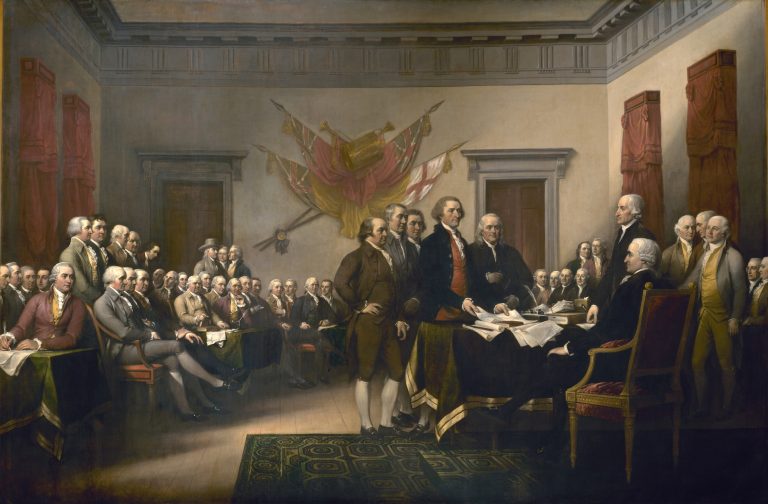
When you close your eyes and try to imagine in your mind the physical appearance of our Founding Fathers, what do you see? Of course, there were no photos taken in 1776, but the drawings and portraits we can look at today tend to give us a picture of old, distinguished fellows, stately men wearing their powdered wigs.
A Young Jefferson
Now, with that picture in my mind, it’s hard for me to imagine that they were regular people just like you and me. But did you know that so many of the signors of our Declaration of Independence were not old men at all? That’s right, and one of the young men in that group was Thomas Jefferson.
It’s hard to believe, but when Thomas Jefferson wrote the draft for our Declaration of Independence, he was only age 33 – that’s amazing!
Jefferson as Delegate Alternate
But even more amazing is the fact that Jefferson wasn’t even supposed to be there at that Continental Congress. Wow!
You see, in 1775, when the Virginia Convention selected their delegates to go to the Continental Congress meeting in Philadelphia, they chose a man by the name of Peyton Randolph to represent them at that Congress, not Thomas Jefferson. Jefferson was picked as the alternate, to go only if for some reason Peyton Randolph could not go.
Surely that would never happen, but it did; delegate Peyton Randolph could not go, so Virginia’s second choice, alternate Thomas Jefferson, traveled to Philadelphia for that crucial meeting as a substitute.
Personal Notes
Now, there is a little bit of information here on Thomas Jefferson that you may not know. First, he was a very quiet man who rarely spoke publicly. But despite his reluctance to speak publicly, he was an amazing communicator. In fact, over the course of his lifetime he wrote over 16,000 letters. He was fluent in five languages and was able to read two other languages. In addition, he was a lawyer, a scientist, and he played a variety of musical instruments, including violin, cello, and clavichord. He was also an author, an architect, and even an inventor. It is no doubt, he was quite an amazing fellow.
Fires of Freedom
But how did he come to write the Declaration of Independence if he was only an alternate delegate?
Well, it’s not known just when the first fires of freedom were born in Jefferson’s heart and soul. However, he was in attendance (ten years earlier) in 1765 when Patrick Henry gave his powerful, defiant speech against the Stamp Act. That speech set Jefferson on his journey to freedom. His ideals and theories about self-governance and the rights of people were powerful.
Before Jefferson even left for that Congressional meeting in Philadelphia, he wrote down certain thoughts and ideas about freedom and he sent them ahead. He called these thoughts, “A Summary View of the Rights of British American.”
But on his way to the convention, Thomas Jefferson became very ill, and he had to delay his journey for a few days.
But when his papers arrived before him and were read by the other delegates, his words were so enlightening, so powerful, and so revolutionary, that the papers were immediately published as a pamphlet and circulated to the delegates.
So, by the time alternate delegate Thomas Jefferson arrived at the meeting, his words and ideals had already struck a “Chord for Freedom.” And that’s why he was given the task of writing that first draft of our Declaration of Independence—and, amazingly, only minor changes to its content before it was passed out.
A Strange Twist
One last strange twist in the life of Thomas Jefferson – he died on July 4th, 1826, exactly 50 years to the date his Declaration of Independence was formed. On his death bed, Jefferson told his good friend James Madison that of all the things he wished to be remembered for, he wanted to be remembered first and foremost as the author of our nation’s Declaration of Independence.
Mr. Jefferson, we have not forgotten.
Happy 250 Year Anniversary America!
Jerry Stewart is a syndicated radio producer and author whose programs, including One Moment in America and You Are There, are broadcast on over 400 stations nationwide.
www.jerrystewartusa.com